
This blog is part of a multi-part series designed to answer common questions about our photography agreement and explain certain contract terms in simpler, more practical language.
When hiring an Austin event photographer, most clients are focused on the same things: getting great images, having a smooth experience, and knowing exactly what to expect. That is how it should be. But like any professional service, photography comes with terms that help define what is included, how the images may be used, and when a request falls outside the original scope of work.
We know some contract language can sound more formal than everyday conversation. That does not mean the goal is to make things confusing or difficult. Our goal is the opposite. We want to be easy to work with, clear in our communication, and transparent about what is included, what is not, and why certain terms exist in the first place.
At the same time, clear boundaries matter. They protect both the client and the photographer, reduce misunderstandings, and help ensure the business can continue operating in a professional and sustainable way. In other words, these terms are not just about protection. They are about clarity, fairness, and making the working relationship smoother for everyone involved.
As an Austin event photographer, part of our job is not just creating strong images. It is also making sure clients understand the process, the deliverables, and the value behind the work. In this series, we will break down some of the most common terms and concepts in our agreement so the average person can better understand what they mean and how they apply in real-world situations.
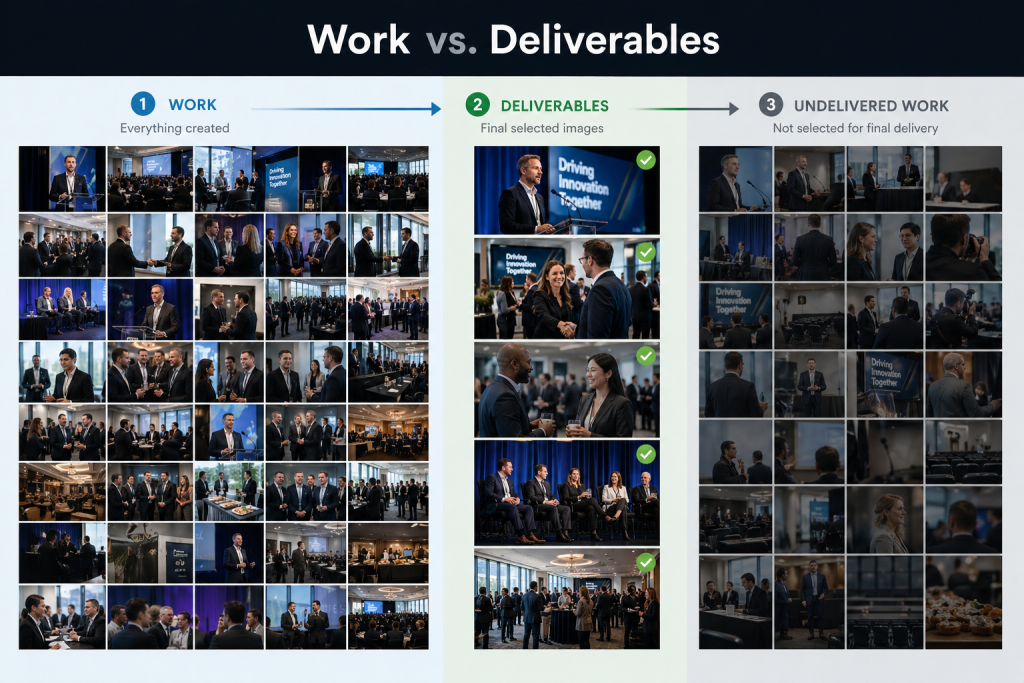
One of the biggest misunderstandings in professional photography is the idea that everything created during a shoot is automatically part of the final delivery. That is usually not how it works.
“Work” refers to everything created during the assignment. That includes test shots, alternate frames, near-duplicates, setup images, rejected captures, and final selected images. “Deliverables” are the final agreed-upon images actually selected and delivered to the client. “Undelivered Work” refers to everything created during the process that is not chosen for final delivery.
For example, if I photograph a speaker, executive, or leadership team, I may take several frames to capture the strongest expression, cleanest composition, and best overall result. The image you receive is the deliverable. The other frames are part of the creative process, but they are not part of the final product.
That distinction matters because you are not simply hiring someone to click a shutter. You are hiring a professional to create, refine, and deliver the strongest final images.
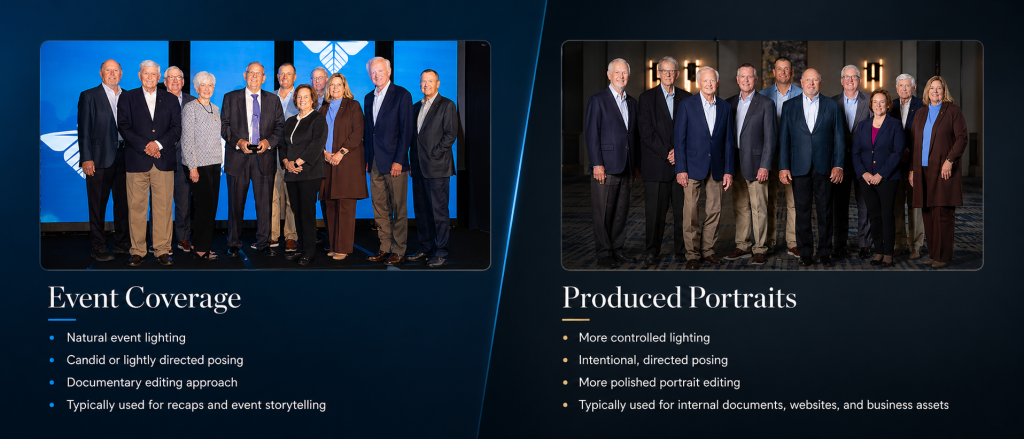
Standard event coverage and produced portrait work are not the same thing, even when both happen during the same assignment.
Event coverage is documentary by nature. It includes the natural flow of the event, such as speakers, networking, attendee interactions, venue details, branding moments, and quick team or group photos captured as part of what is already happening.
Produced portraits are different. These are images created for a specific purpose and usually require a more deliberate approach. That may involve more direction, more attention to posing, more control over composition, multiple takes, or a more refined portrait setup.
For example, if someone says, “Can you grab a quick photo of our team while we’re all together?” that is usually part of normal event coverage. But if the request is, “Can we pull our board members aside and create a polished group image for our website?” that is no longer just event coverage. That is a purpose-driven image being created as a business asset.
That is why some portrait-based requests made during an event may be treated differently from standard event photography.
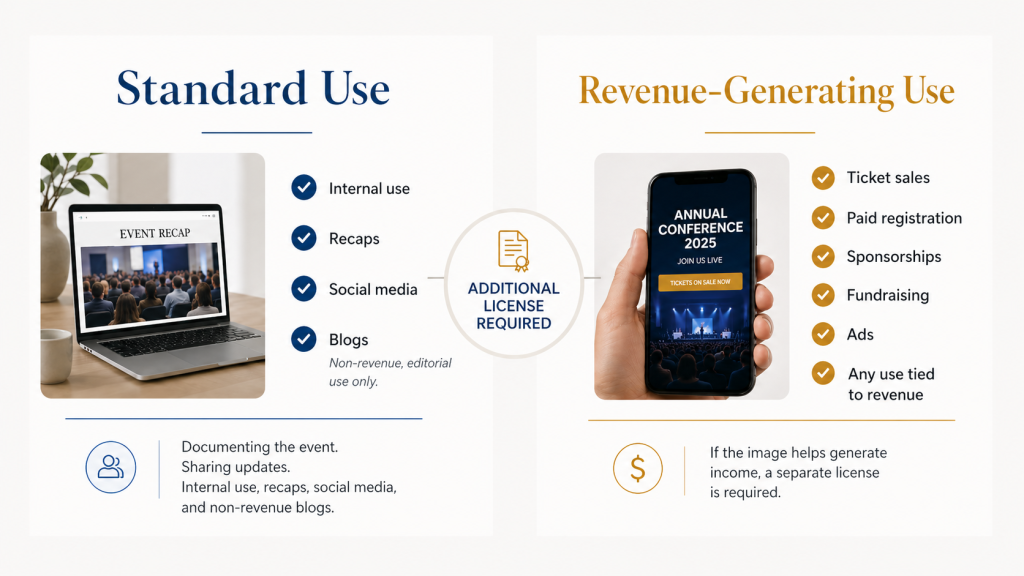
Not every use of a photo carries the same purpose or value.
Some uses are internal. Some are public-facing but editorial in nature, meaning they simply document or recap what happened. Others are commercial in nature because they help promote a business, attract attention, generate leads, support sponsorship, increase registrations, or move people toward a revenue-producing goal. Because those uses create different kinds of value, they are treated differently in the agreement.
In simple terms, the standard license generally allows the client to use the delivered images for internal business use and for non-paid, editorial-style public use related to the assignment. That typically includes company presentations, recap decks, internal reporting materials, website recaps, organic social media posts, newsletters, and press releases that share the event in a natural, non-advertising way.
What is not included under the standard license is use of the images as commercial assets to market, promote, sell, recruit, solicit, fundraise, or otherwise support a business objective.
For example, posting event photos in a recap on your website or LinkedIn page to show what took place is very different from using those same photos to sell tickets, attract sponsors, promote a service, drive registrations, build a mailing list, or support a campaign. In the first case, the images are documenting the assignment. In the second, the images are helping create commercial value.
That is why promotional use is treated differently and may require separate written approval.
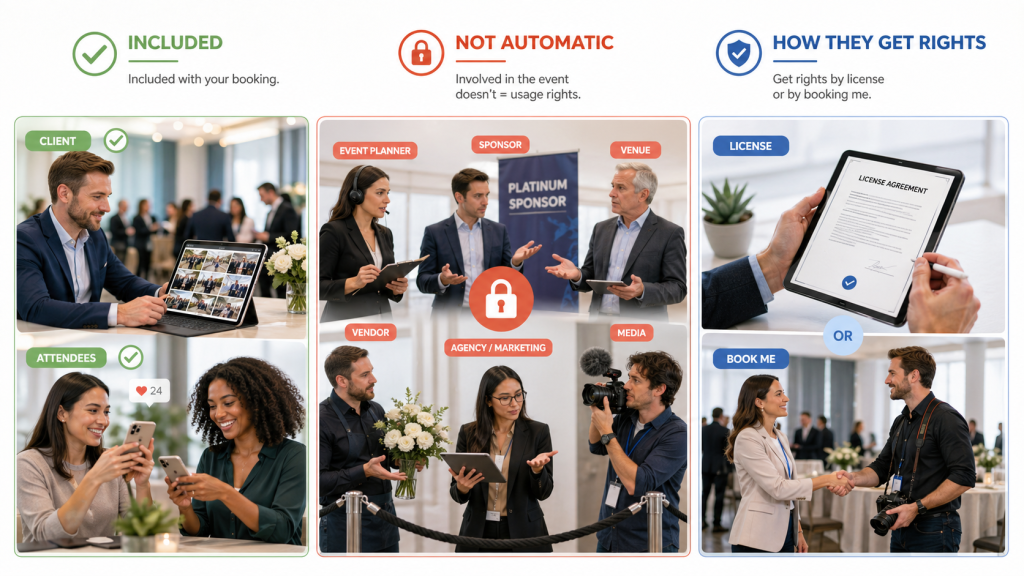
Another common misunderstanding is assuming that anyone connected to the event automatically has the right to use the photos. In most cases, that is not how licensing works.
The license is generally granted only to the named client. That means planners, agencies, sponsors, venues, vendors, media outlets, and other outside parties do not automatically receive usage rights just because they were involved in the event.
For example, if an event planner coordinates the booking, that does not automatically give the planner permission to use the images for their own website, social media, or marketing. In the same way, if a sponsor or venue appears in the event, that does not automatically mean they can use the photos for their own business purposes.
Those rights must be separately approved in writing.
For companies, agencies, and event teams with recurring photography needs, expanded usage options may be available through the AJP Partner Program. This program is designed for clients who need a more streamlined approach to ongoing photography, brand usage, sponsor-related permissions, and recurring event coverage.
This matters because the value of an image changes depending on who is using it, how it is being used, and the business value that usage creates.
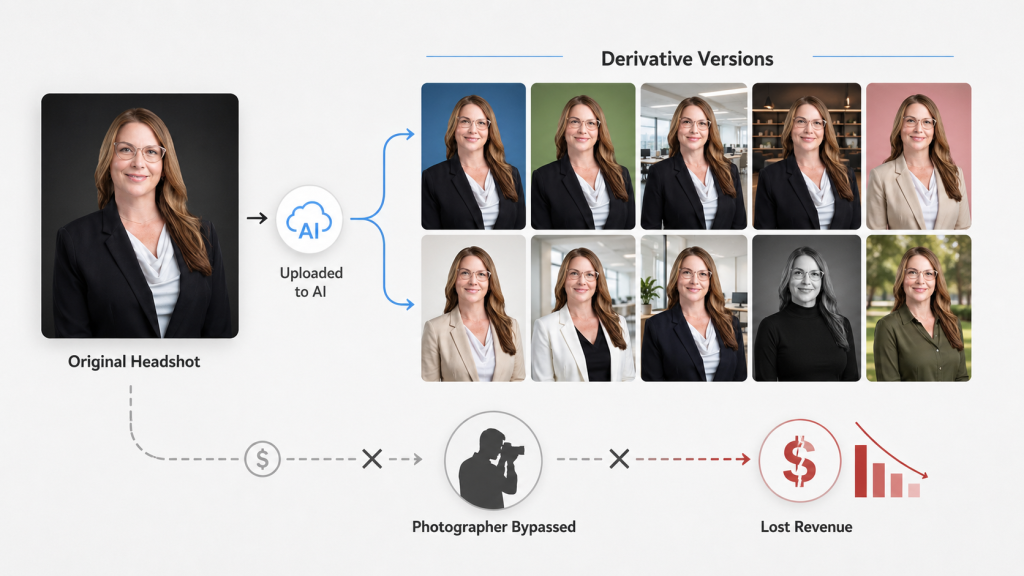
A derivative work is any altered or modified version of an original image. That can include heavy retouching, design manipulation, composites, AI-generated variations, graphic treatments, or other changes that turn the original photograph into something new.
For example, if someone takes a delivered image and changes the background, adds heavy design elements, turns it into a stylized promotional graphic, or uses AI to generate a modified version, that may be considered a derivative work rather than simple use of the original photo.
This matters because the right to use a delivered image does not automatically include the right to alter it however someone wants.

The purpose of this language is clarity from the start.
When a company hires us, it is important to define upfront how the images are expected to be used. That helps shape the scope of the assignment, the level of service being provided, and the license attached to the final deliverables. If the intended use changes later or expands beyond what was originally agreed to, that is typically treated as additional usage and billed separately.
In most cases, clients only need internal use, editorial-style communications, and post-event recap usage. But when an image turns out especially strong, that does not automatically mean it can also be used for marketing, advertising, promotions, or other commercial purposes. The value of an image is tied not just to how it looks, but to how it is being used.
That is why this language matters. It protects both parties, sets expectations clearly, and helps ensure the working relationship stays professional, fair, and easy to navigate.
The best client relationships are built on clarity. When everyone understands what is included, how the images can be used, and where the boundaries are, the process becomes easier, more professional, and more valuable for everyone involved.
If you have questions about how a specific use, request, or deliverable fits into your agreement, ask before the assignment. It is always easier to define expectations up front than to fix confusion later.